
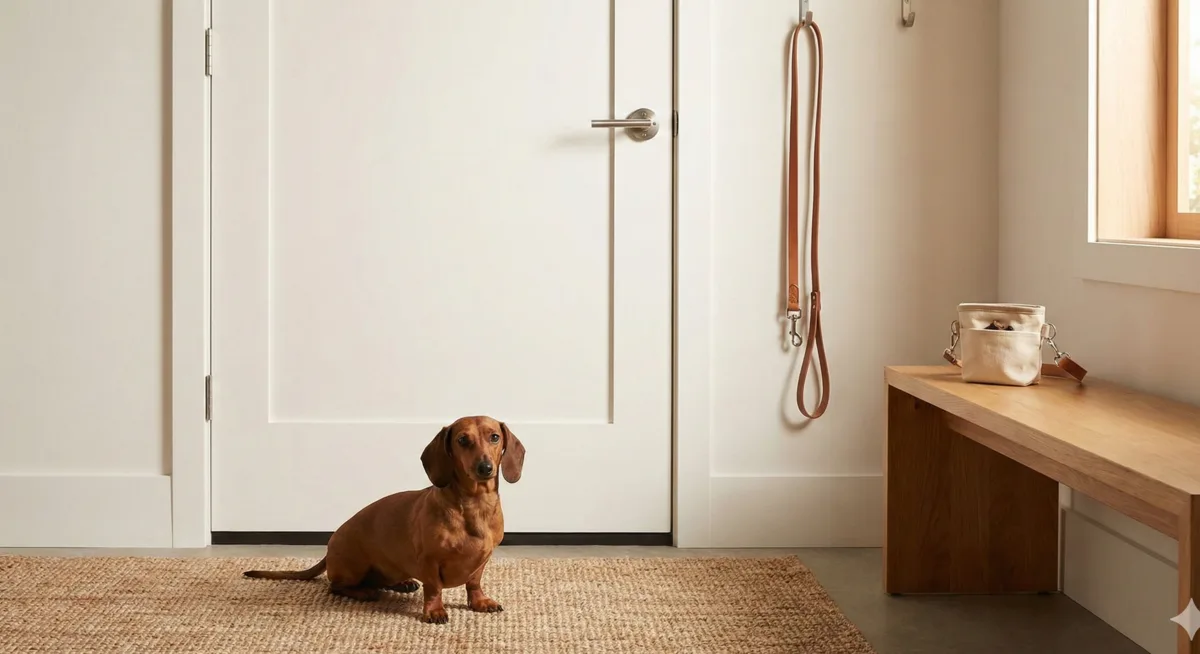

Door barking is normal in dachshunds. They are alert, vocal, and quick to react when movement or sound hits the entryway. The objective is not to silence your dog forever. The objective is to replace frantic alarm behavior with a predictable response that you can manage when guests, deliveries, and hallway noise happen.
Quick card
Quick Card: Door barking
Quick takeaways
- Manage the environment first, then train behavior.
- Reinforce the first second of quiet.
- Teach a default station (mat/bed) near but not at the door.
- Keep guest arrivals scripted until the behavior stabilizes.
- Expect progress in waves, not a perfectly linear trend.
Table of contents
- Why door barking escalates fast
- Step 1: Management before training
- Step 2: Teach a reliable place behavior
- Step 3: Run a repeatable guest-entry script
- Step 4: Troubleshoot setbacks
- Evidence and references
Why door barking escalates fast
Many dogs practice barking dozens of times per week with no structured alternative. Every successful “intruder goes away” event can accidentally reinforce the behavior from the dog’s perspective.
Escalation drivers:
- High-contrast triggers (doorbell sounds, footsteps, knocks).
- Visual access to the street or hallway.
- Inconsistent owner responses.
- Overthreshold training (trying to train while the dog is already fully aroused).
For dachshunds, this pattern can become loud quickly because they are both vigilant and persistent.
Step 1: Management before training
Management reduces rehearsal so your training has a chance to work.
Practical setup:
- Use window film, curtains, or strategic furniture placement to reduce visual triggers.
- Lower bell volume if possible.
- Put a mat or bed in a “station” zone away from the direct doorway line.
- Keep treats in one fixed location near the door.
Rules for management:
- No yelling over barking.
- No repeating cues when the dog cannot respond.
- If arousal spikes, increase distance from the door and reset.
Step 2: Teach a reliable place behavior
You need a behavior that is incompatible with charging the door.
Build the cue in a quiet context
- Lure dog onto mat.
- Mark and reward while all four paws are on mat.
- Add cue word (“place”).
- Add short duration (2-5 seconds), then release.
Add mild door sounds later
- Tap the wall softly, cue “place,” reward success.
- Progress to soft knock.
- Progress to low-volume bell.
Criteria before you progress:
- Dog reaches mat quickly.
- Dog can hold place briefly.
- Bark intensity is lower and recovery faster.
Step 3: Run a repeatable guest-entry script
Most households fail here because every arrival is improvised.
Use this script:
- Before opening door, cue “place.”
- Reward quiet on mat.
- Open door only while dog remains under threshold.
- If barking surges, close door and reset.
- Ask guest to ignore dog for first minute.
Delivery variation:
- For short deliveries, do not open wide and create long arousal windows.
- Use the same cue sequence every time.
Consistency matters more than intensity. Ten calm reps beat one chaotic “big correction” attempt.
Step 4: Troubleshoot setbacks
”My dog barks before I can cue”
You are too close to trigger onset. Pre-cue earlier and reduce trigger intensity.
”It works with family but not with guests”
Generalization gap. Schedule controlled practice with one predictable helper.
”Barking returns after a few good days”
Normal regression. Keep structure and reduce criteria briefly.
”My dog seems panicked, not just excited”
Lower difficulty and talk to your veterinarian or a qualified behavior professional if fear signs are persistent.
Safety and escalation notes
Seek veterinary guidance if barking changes suddenly with:
- Sleep disruption.
- New clinginess or pacing.
- Sensitivity to touch or movement.
- Signs of pain or neurologic discomfort.
Behavior change plans are most effective when physical discomfort is ruled out first.
Frequently asked questions
Q: Should I punish barking at the door? A: Punishment can suppress signals short term but often increases stress. Rewarded alternative behaviors are typically more durable.
Q: How long until results? A: Many owners see better recovery within 1-2 weeks and stronger consistency over 4-6 weeks.
Q: Should visitors pet my dog immediately to calm them? A: Usually no. Start with neutral entries and allow calm settling first.
Q: What if I live in an apartment with constant hallway noise? A: Prioritize sound management, white noise, and short daily training reps during lower-traffic windows.
Related reads
- Leash training for dachshunds who pull
- Crate training a dachshund at night (without the guilt)
- Housebreaking a dachshund: a calm, repeatable schedule
Evidence and references
- AKC: How to stop nuisance barking
- AVSAB position statements and behavior resources
- Humane World for Animals: Positive training approaches
Author
Doxie Lowdown Team