For dachshunds, car safety is mostly about restraint and stability. Their long back and short limbs make sudden movement and awkward positioning riskier than many owners realize. A safe setup does not need to be complicated. It needs to be anchored, repeatable, and calm.
Quick card
Quick Card: Car safety
Quick takeaways
- Never ride with a loose dog or lap-held dog.
- Use a restraint system designed for vehicle travel.
- Keep tether lengths short enough to prevent launch movement.
- Favor stable posture and minimal jumping in/out of the car.
- Build predictable pre-ride routines to lower travel stress.
Table of contents
- Why restraint matters for dachshunds
- Choosing between harness, booster, and carrier
- Setup checklist for safer trips
- Building calm ride behavior
- Common mistakes and how to fix them
- Evidence and references
Why restraint matters for dachshunds
A moving vehicle introduces forces your dog cannot self-manage. During sudden braking, even a short shift can create neck/back load and secondary impact risk.
Risks of unrestrained travel:
- Injury from impact with console/seat/backrest.
- Driver distraction risk.
- Ejection or escape risk after a collision.
- Poor recovery after abrupt turns/stops.
Restraint reduces motion amplitude and helps keep your dog in a safer zone.
Choosing between harness, booster, and carrier
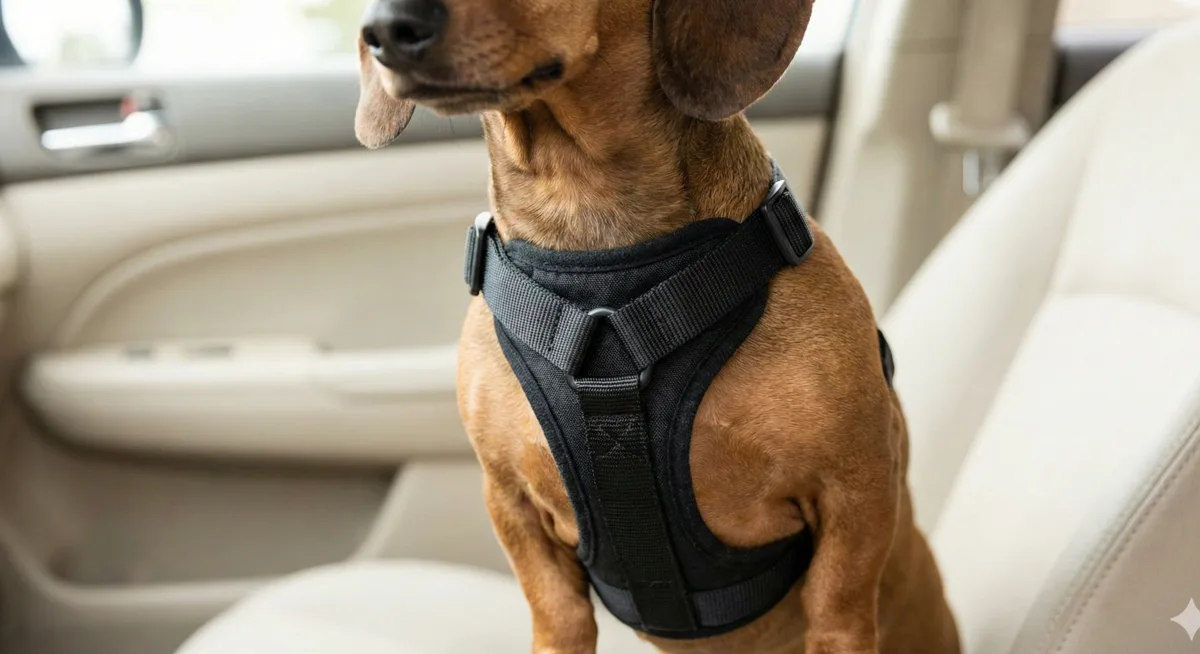
Crash-considered harness systems
Best for dogs that tolerate body-worn restraint and sit/lie calmly.
Look for:
- Broad chest support.
- Durable attachment points.
- Compatibility with short, secure car tethering.
Secured booster seats
Good for smaller dogs that settle better with defined boundaries.
Look for:
- Anchor points that secure to seat structure.
- Internal tether attached to a harness, not a collar.
- Stable base with minimal wobble.
Secured carriers/crates
Best for some anxious dogs who relax in enclosed spaces.
Look for:
- Crash-focused design evidence from manufacturer/testing groups.
- Proper anchoring.
- Size that allows comfortable turn/settle without excessive free movement.
Setup checklist for safer trips
Use this checklist before driving.
- Harness fit check (two-finger rule, no twisting).
- Tether or anchor check (short enough to limit launch).
- Seat position stable (no tilt, no wobble).
- Ventilation/temperature check.
- Ramp or assisted entry to reduce jumping.
Entry and exit protocol
- Use one cue for loading (“car time”).
- Assist with ramp/lift instead of jump-in when possible.
- Exit only on cue after vehicle is fully stopped and door area is controlled.
Building calm ride behavior
A secure setup works best when paired with behavior routine.
Phase 1: Parked-car acclimation
- Sit in parked car for 2-5 minutes.
- Reward calm body language.
- End before stress escalates.
Phase 2: Short movement reps
- Drive 3-8 minutes on familiar route.
- Keep turns/braking smooth.
- End with neutral recovery at home.
Phase 3: Real trip progression
- Extend duration gradually.
- Include breaks on long drives.
- Keep pre-ride process identical each time.
Signs of improving car confidence:
- Faster settle after clipping in.
- Less vocalization.
- Better recovery after turns/stops.
Common mistakes and how to fix them
Mistake: Using a walking harness for crash situations
Fix: Use systems specifically designed and marketed for vehicle restraint use.
Mistake: Excessively long tether
Fix: Shorten to reduce forward travel during braking.
Mistake: Letting dog ride unrestrained “for short trips”
Fix: Use full setup for every trip to maintain safety and routine consistency.
Mistake: Jumping in/out repeatedly
Fix: Use ramp or assisted lifting to reduce spine strain.
Travel day essentials
- Water and collapsible bowl.
- Absorbent towel.
- Backup leash/harness.
- Familiar blanket for stability.
- Waste bags and cleaning wipes.
For long drives, include planned decompression breaks and avoid peak heat windows.
Frequently asked questions
Q: Is a booster always safer than a harness? A: Not always. Safety depends on how well the system is secured, how your dog tolerates it, and whether movement is well controlled.
Q: Can my dachshund ride in front seat? A: Rear-seat restraint is generally preferred for safety.
Q: My dog paces and cries in the car. Should I remove restraint? A: No. Keep restraint and reduce trip intensity while behavior-training calm responses.
Q: Do I need separate travel and walking gear? A: Often yes. Vehicle restraint needs are different from normal walk convenience gear.
Related reads
- Best harnesses for long backs: what to look for
- How to safely lift a dachshund (without stressing their back)
- Road trips with a dachshund: checklist and setup guide
Evidence and references
- Center for Pet Safety: restraint testing resources
- American Veterinary Medical Association pet-owner safety resources
- AKC travel and car safety guidance
Author
Doxie Lowdown Team