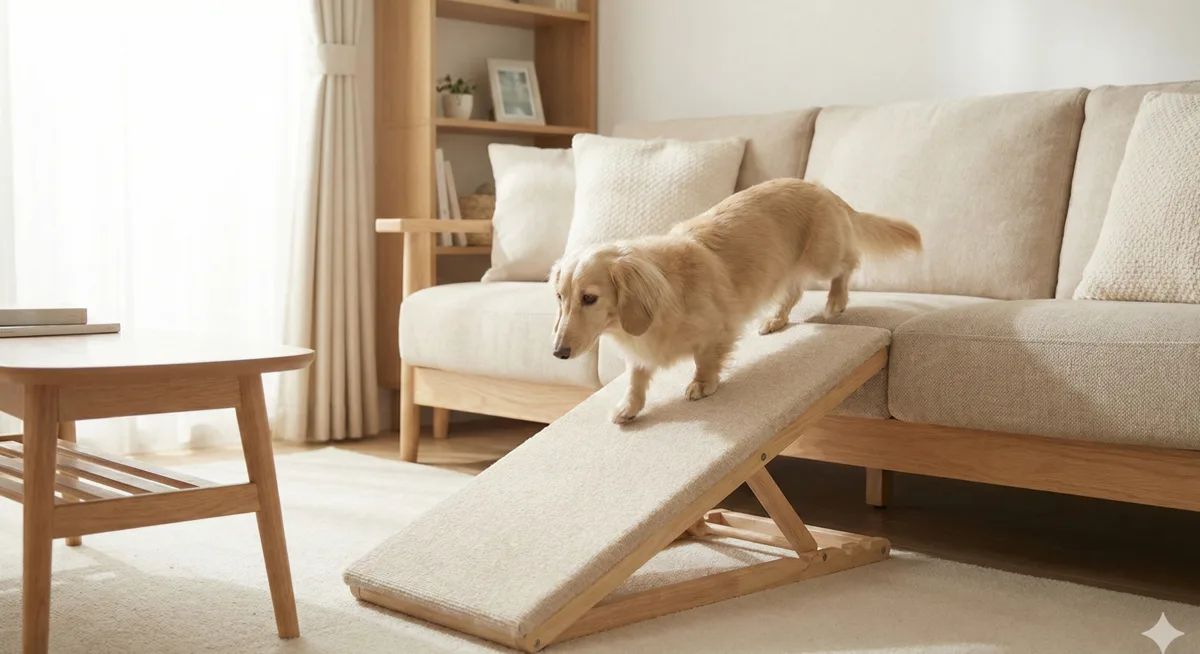
Most ramp advice online is generic: “Buy a ramp and train your dog.” That is not enough for long-backed dogs when your layout, flooring, and furniture height are all different.
This page gives you a 14-day field log protocol so you can make a data-backed decision about whether your ramp setup is truly working.
Quick card
Quick Card: Ramp field log
What makes this guide different
- Uses measurable outcomes (hesitations, successful ascents, slip events), not vibe-based opinions.
- Includes a free log you can download and use immediately.
- Ties setup decisions to clear stoplight thresholds (green/yellow/red).
Table of contents
- How to set your test baseline
- Your 14-day ramp protocol
- Green/yellow/red pass rules
- Downloadable log templates
- Common failure patterns and fixes
- Weekly review method that takes 10 minutes
How to set your test baseline
Before day one, capture these baseline details:
- Furniture height in inches (floor to top landing surface).
- Ramp length in inches (actual usable walking surface).
- Ramp surface material (carpet, grip tape, rubber tread, etc).
- Floor type at ramp base (hardwood, tile, rug).
- Dog profile (age, confidence level, current pain concerns).
If you need an angle estimate first, use the Ramp Angle Planner.
Your 14-day ramp protocol
Run two controlled sessions each day:
- Session A: first morning furniture access.
- Session B: evening furniture access.
For each session, log:
- Number of attempts.
- Successful ascents.
- Hesitations (pause >2 seconds before stepping on ramp).
- Slip events (paw slip, slide, or jump-off bailout).
- Handler assist used (yes/no).
Do not “coach away” problems during logging. You want honest behavior data.
Green/yellow/red pass rules
Use this score after day 14.
| Metric (14-day total) | Green | Yellow | Red |
|---|---|---|---|
| Success rate | >=90% | 75-89% | <75% |
| Hesitations per day | <=1 | 2-3 | >=4 |
| Slip events total | 0-1 | 2-3 | >=4 |
| Handler assists per day | <=1 | 2 | >=3 |
Decision rules
- Green: keep setup, recheck monthly.
- Yellow: optimize one variable (angle, surface grip, or base traction) and re-run 7 days.
- Red: stop using this setup and redesign ramp geometry before further use.
Downloadable log templates
- Ramp Field Log (CSV)
- Ramp Field Log (Printable worksheet) - clean, branded page that prints to PDF cleanly.
- Doxie Worksheet Pack (all downloads)
Common failure patterns and fixes
Pattern 1: High hesitation, low slips
Your dog likely lacks confidence, not traction.
- Reduce angle.
- Add two daily “treat run” sessions with no pressure.
- Keep landing and takeoff zones clear.
Pattern 2: Low hesitation, high slips
Confidence is okay, traction is failing.
- Add grip overlay.
- Add non-slip rug under base.
- Check ramp for wobble.
Pattern 3: Good day 1-3, then worse
Usually fatigue or setup inconsistency.
- Check if ramp position shifts through the day.
- Keep one fixed path and avoid moving the ramp.
- Shorten session count while confidence rebuilds.
Weekly review method (10 minutes)
At the end of each week:
- Calculate success percentage.
- Mark top failure trigger (angle, surface, placement, or context).
- Change one variable only.
- Repeat for seven more days.
Single-variable changes are the fastest way to discover what actually helped.
FAQ
Q: Should I change two things at once to save time?
A: No. If two things change, you cannot isolate what fixed the issue.
Q: Is one bad slip event enough to stop?
A: It depends on severity, but repeated slips always require setup changes.
Q: Can this replace veterinary guidance?
A: No. This is an owner workflow tool. If your doxie shows pain, weakness, or behavior changes, call your vet.
Related reads
- Dachshund Back Safety at Home: Ramps, Lifting, and Simple Rules
- Stairs vs Ramps for Dachshunds
- How to Safely Lift a Dachshund
Author
Doxie Lowdown Team